Ground-based surveys for microlensing have been obtaining timeseries imaging of
the Galactic bulge continuously since 1990. As a result, there are substantial catalogs
of very-long-baseline timeseries photometry. These surveys are summarized below,
with links to available datasets and other resources where available.
OGLE: The Optical Gravitational Lensing Experiment
OGLE is one of the most established surveys in microlensing, having been in continuous operation since 1992. During this time the total area
footprint of the survey has dramatically increased thanks to upgrades to its primary imaging camera, now on its 3rd version. The OGLE survey is outstanding in particular for
the quality of its photometry and for its long baseline of observations. This has enabled the group to compile deep reference images and catalogs of known variable stars which
are used to exclude false-positive detections. As a result, OGLE issue a very reliable stream of public alerts of microlensing events in progress, which are available via their website or
by subscribing to the OGLE mailing list.
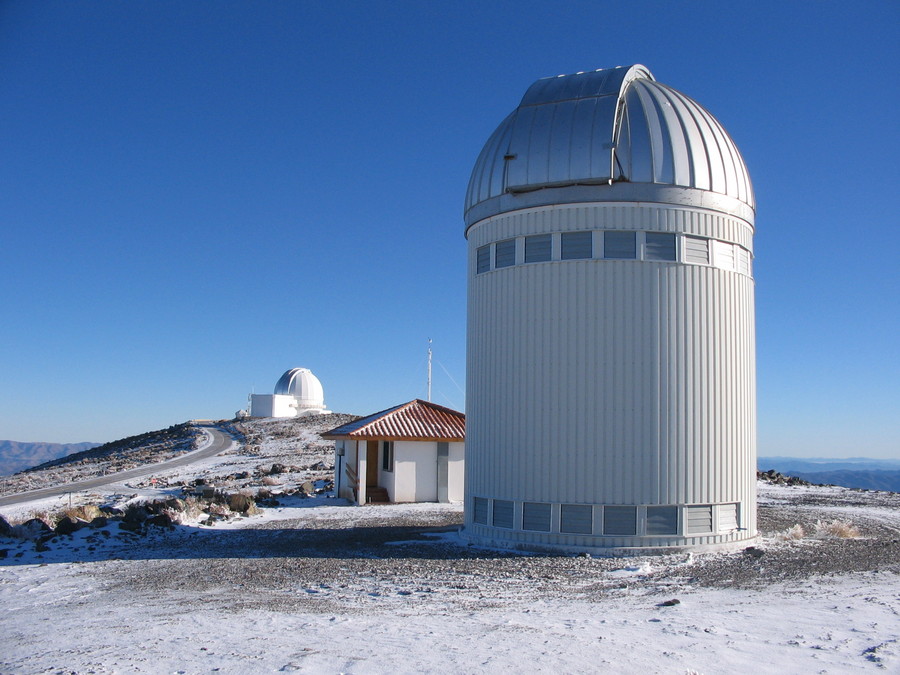
The 1.3m Warsaw Telescope, Las Campañas Observatory, Chile [OGLE]
MOA: Microlensing Observations in Astrophysics and PRIME: Prime-focus Infrared Microlensing Experiment
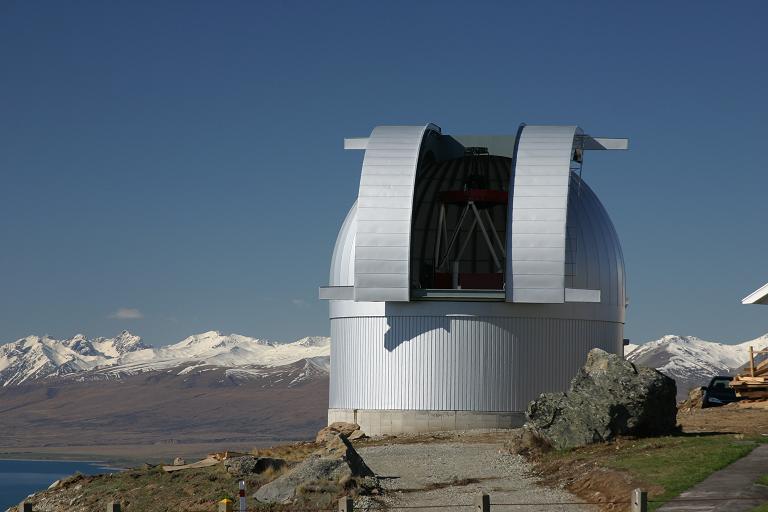
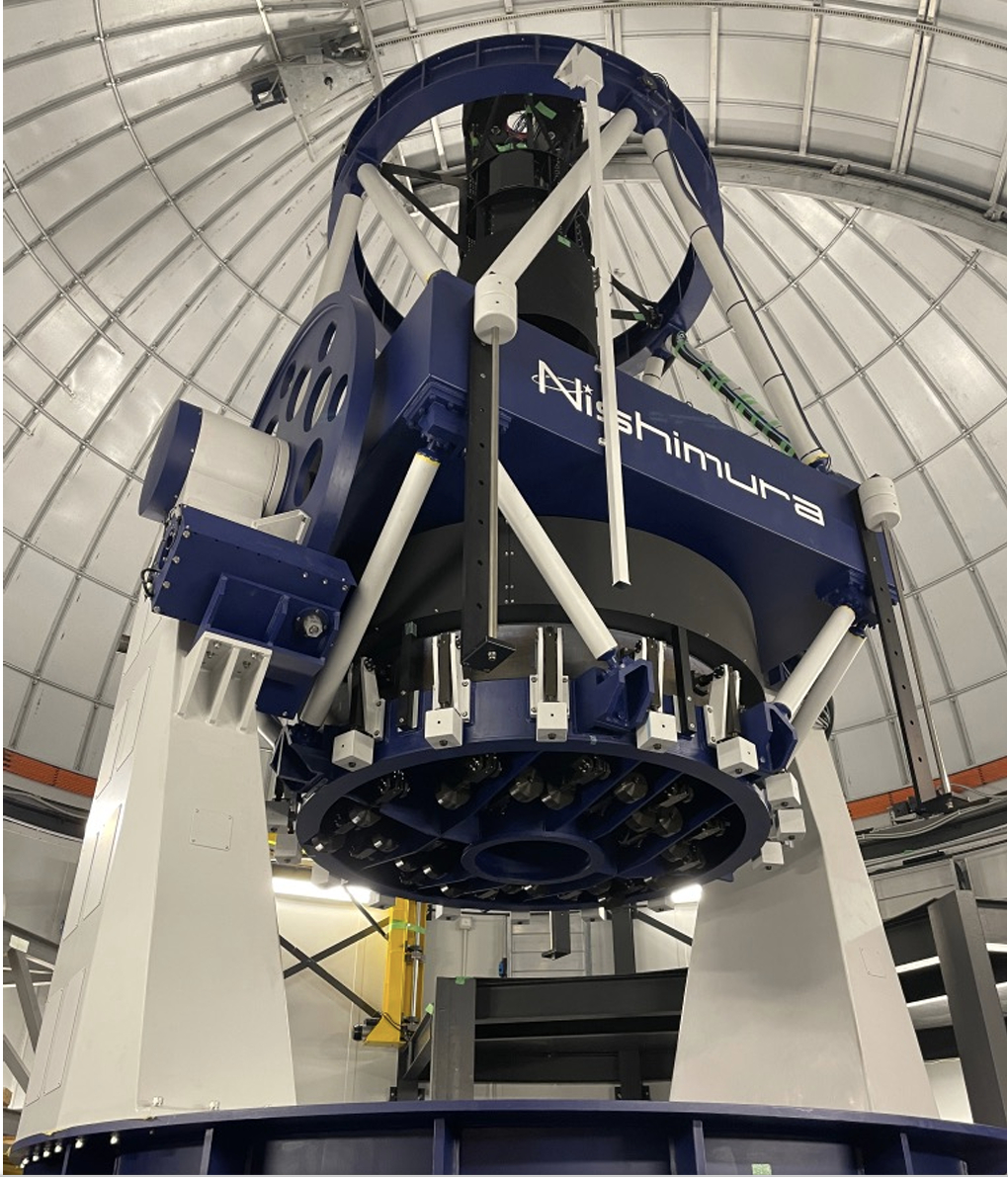
(Left) The 1.8m Telescope, Mt. John Observatory, New Zealand and (right)
the 1.8m PRIME Telescope, South African Astronomical Observatory [MOA/PRIME; Sumi et al.(2025)]
The MOA project represents a long-standing multi-national collaboration between Japan, New Zealand
and the USA, beginning in 1995 with the 0.6m Boller & Chivens Telescope, and progressing to the
purpose-built 1.8m telescope in 2003, which greatly increased the survey footprint, photometric
depth and resolution. MOA operates a particularly rapid-response public alert system for
microlensing events and cataclysmic variable stars, available via their website and their mailing
list. They have also pioneered the introduction of alerts sent to a cell phone app, available for
the Android platform.
In 2025 the same team inaugurated the new 1.8m PRIME Telescope at the South African Astronomical Observatory.
Unlike all previous microlensing surveys, the PRIME Telescope is optimised for near-infrared observations,
and so is complementary to other surveys on the ground and in space.
KMTNet is distinct from other ground-based surveys in that it operates a set of identical telescopes
across three sites in Australia, South Africa and Chile. The advantage of this is that it enables
the network to monitor the survey fields around the clock. KMTNet began operations in 2013-2014.
A site of the 1.6m KMTNet Telescopes [KMTNet]
Operated by
Korea Astronomy and Space Science Institute, South Korea
Director of microlensing program
Andy Gould, Max Planck Institute Heidelberg, Germany
Siding Spring, Australia, Cerro Tololo Inter-American Observatory, Chile, South African Astronomical Observatory, South Africa
Field of view
2 x 2 degrees
Pixel scale
0.40 arcsec/pixel
Passbands
V, R, I
LSST: NSF/DOE’s Rubin Observatory’s Legacy Survey of Space and Time
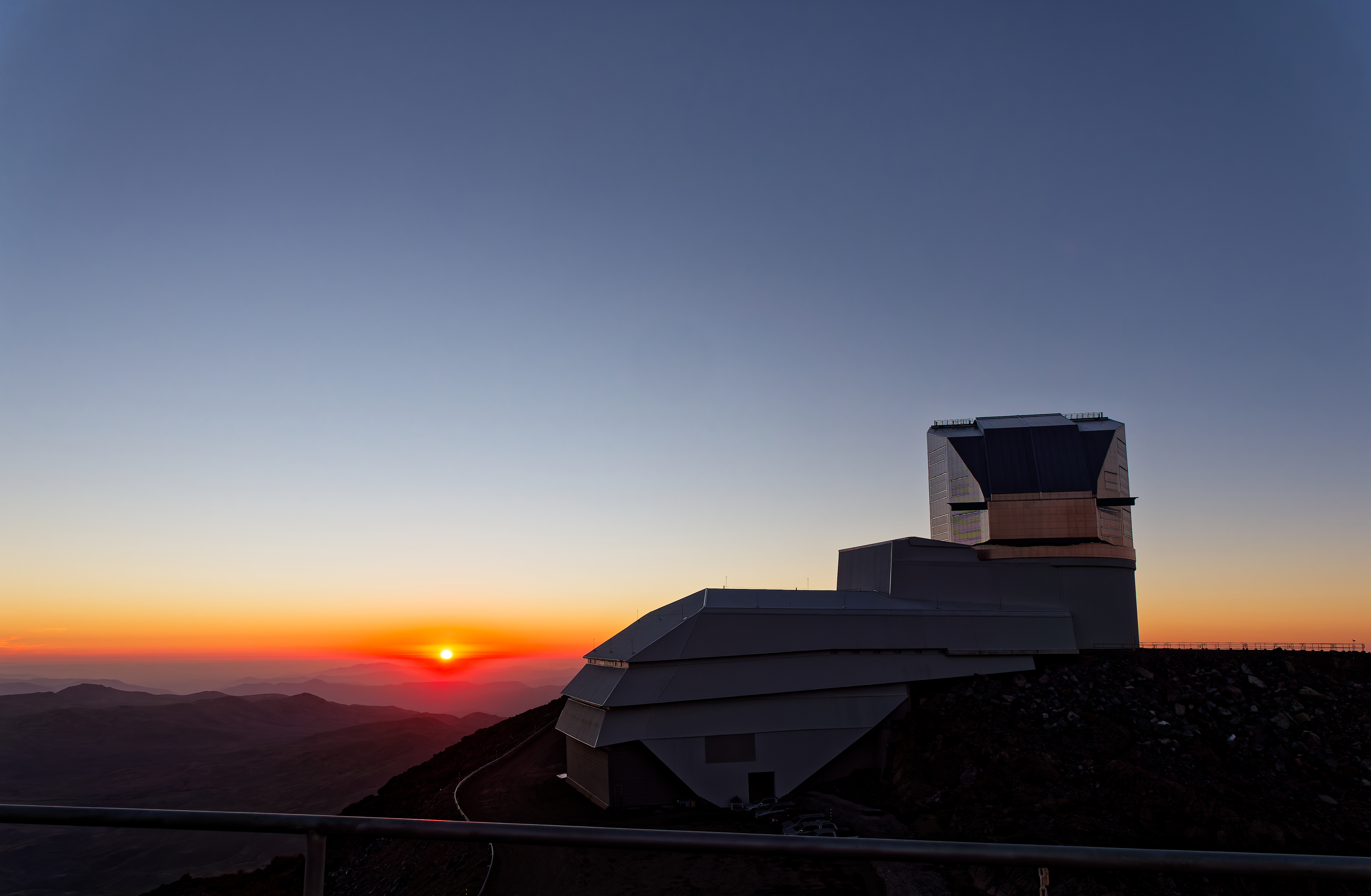
The Rubin Observatory [NSF–DOE Rubin Observatory/NOIRLab/SLAC/AURA/W. O'Mullane]
Rubin Observatory is a brand-new optical survey telescope build on Cerro Pachón, Chile. It has just
started science operations, and is dedicated to the Legacy Survey of Space and Time (LSST). This
is a time domain survey of the entire visible southern sky in six SDSS filters. One component of LSST
is a survey of a large area spanning the Galactic bulge and plane, where the survey is expected to
detect thousands of microlensing events over its 10-yr lifetime. Rubin's Science Collaborations offer
a way for the wider science community to get involved in the survey, and Rubin's Transient and Variable
Stars Science Collaboration has a very active Microlensing Group.
VVV is an ESO public survey that used the Visible and Infrared Survey Telescope for Astronomy (VISTA)
survey telescope at Paranal Observatory, Chile. It's first generation instrument, the VIRCam, offered
both a wide field of view and spatial resolution. VVV was a public IR multi-epoch survey of a
520 sq.deg. section of the Milky Way bulge and mid-plane, focusing on regions of star formation
activity. The goals of the survey were to characterize all forms of stellar variability in the
infrared over a 6-yr period, including longer-timescale microlensing events. The subsequent VVVx survey
extended the survey footprint to cover 1700 sq. degrees in the Southern sky, from l <=230 deg to l = +20 deg.
VVV data is available through the ESO archive as a public data release.
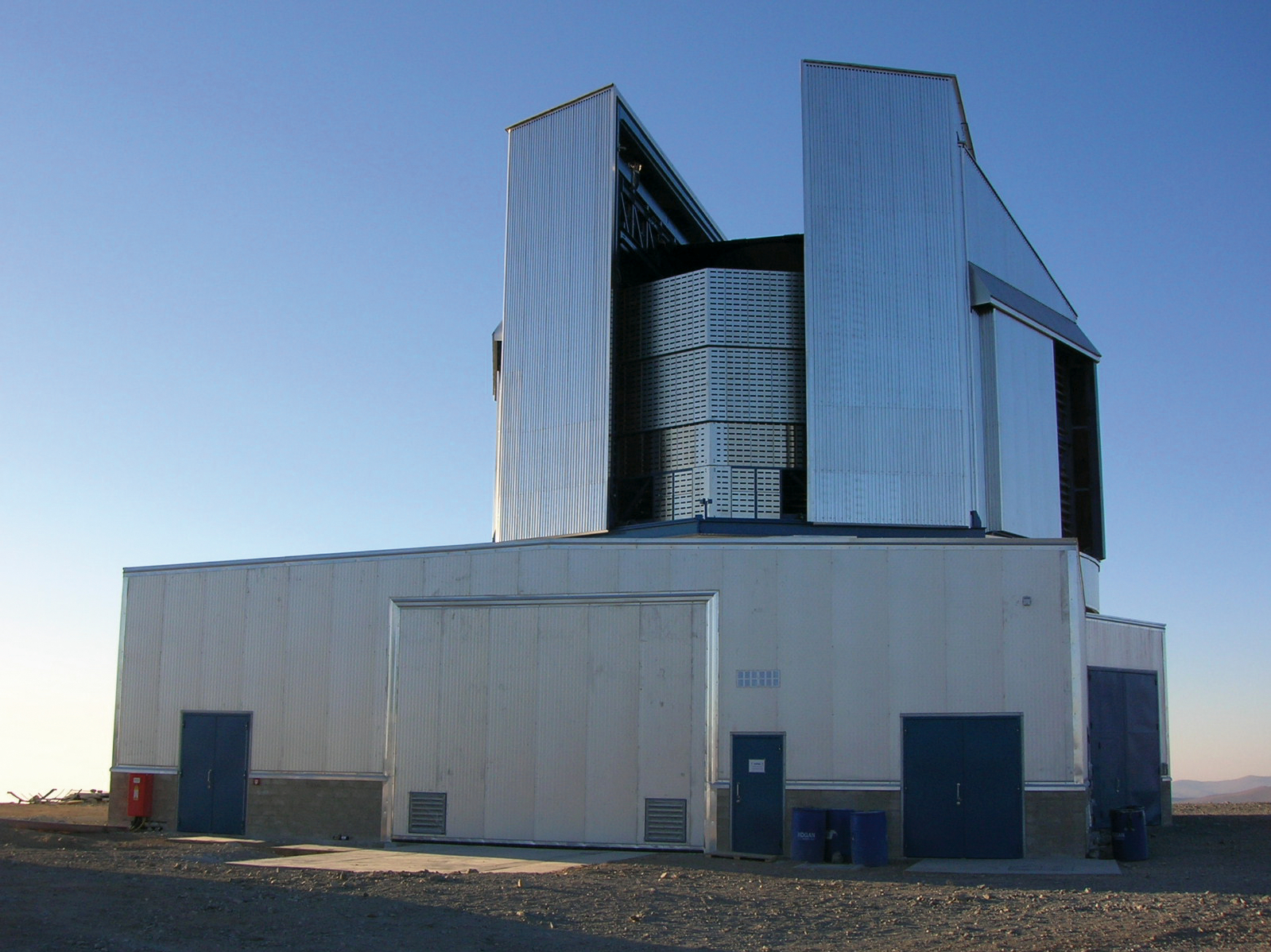
VISTA Survey Telescope, Paranal Observatory, Chile [ESO]
EROS I & II: Expérience pour la Recherche d’Objets Sombres
EROS was one of the first microlensing surveys, with the goal of looking for signs of dark matter in
the Milky Way in the form of hypothesized Massive Compact Halo Objects (MACHOs) and brown dwarfs. The
first phase of the project started in 1990 using the 40cm telescope at La Silla Observatory, Chile and continued to 1995.
Initially, the observing strategy searched for short timescale (1hr to a few days) microlensing events, though none
were found. In addition the project also obtained timeseries observations via photographic plates in
different passbands with the 1m Schmidt ESO telescope. The second phase of the project (1996-2003)
switched to using a twin-CCD camera capable of simultaneously imaging in \(R_{EROS}\) and \(B_{EROS}\) passbands.
This was mounted on the 1m MARLY telescope and concentrated on timeseries observations
of the Magellanic clouds (LMC, SMC), Galactic Centre (CG) and four selected regions in the
direction of Galactic spiral arms.
As the name suggests, the MACHO survey conducted a search for dark matter in the Milky Way between
1992 - 1999. The survey used the 1.27-metre (50-inch) telescope at the Mount Stromlo Observatory in
Australia together with a very wide-field camera. In combination with a beamsplitter, this allowed
the survey to simultaneously image in passbands centered on 560nm and 710nm. The survey performed
timeseries imaging of the Large Magellanic Cloud and the Galactic bulge, with a cadence of twice per
night to weekly. The MACHO project produced the first discovery of a microlensing event
Alcock, C. et al. (1993) Nature, Volume 365, Issue 6447, pp. 621-623,
and were the first team to circulate an alert of an ongoing microlensing event in 1995
Alcock, C. et al. (1995) IAUC 6068.