Estimating Parameters
Introduction
The light curve of a microlensing event encodes a great deal of information. Indeed, many of the most important parameters can be estimated directly from timeseries photometry, and it is helpful to know how to build physical intuition about the events.
Parameterization of a Point Lens Lightcurve
A point lens microlensing event is parameterized by three variables:
- u0 = the impact parameter between the source and the lens (i.e. minimum separation)
- t0 = the time of closest approach between the source and lens (i.e. t at u = u0)
- tE = the Einstein crossing time = the time for the source to travel 1 Einstein radius
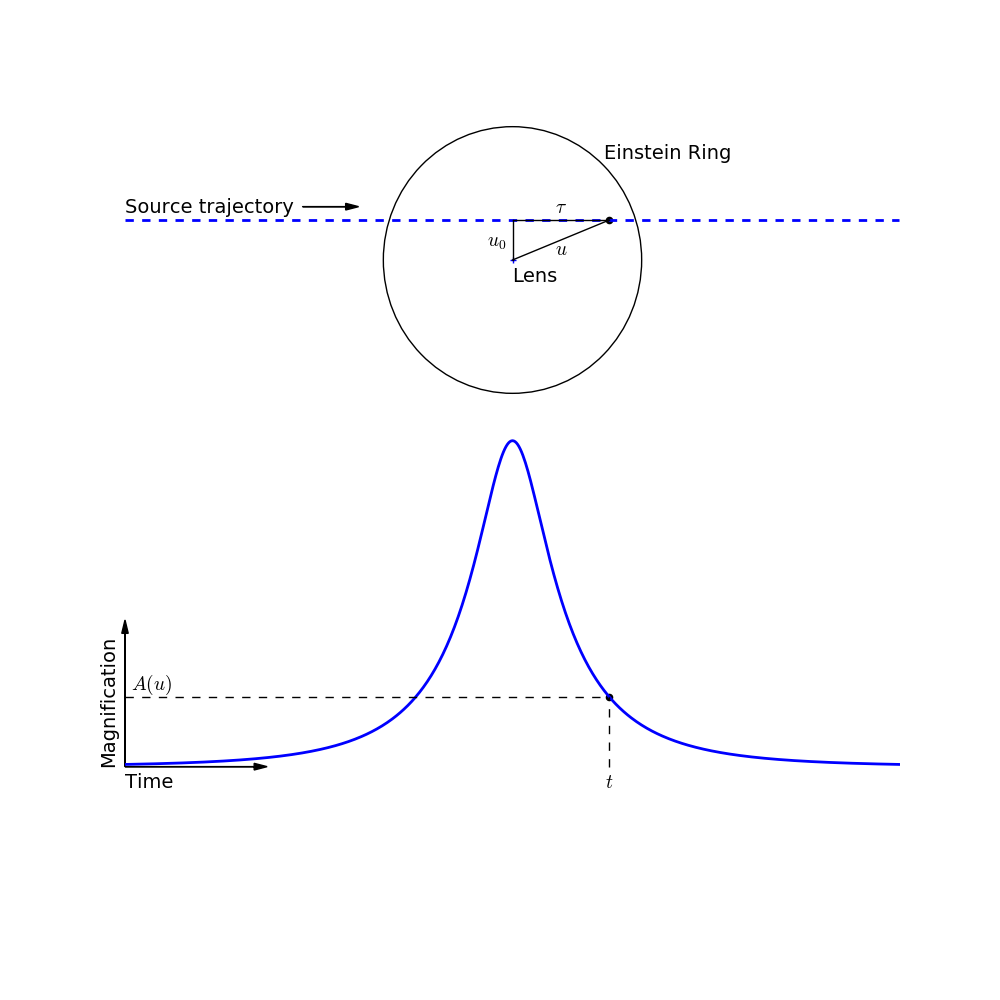
The magnification of the source is given by the equation:
\[A(u) = \frac{u^2 + 2}{u (u^{2} + 4 )^{1/2}}\]where \(u = ( u_0^2 + \tau^2)^{1/2}\) and \(\tau = (t - t_0)/t_{E}\).
t0 is easily estimated from the time of the peak of a point-source, point-lens lightcurve,
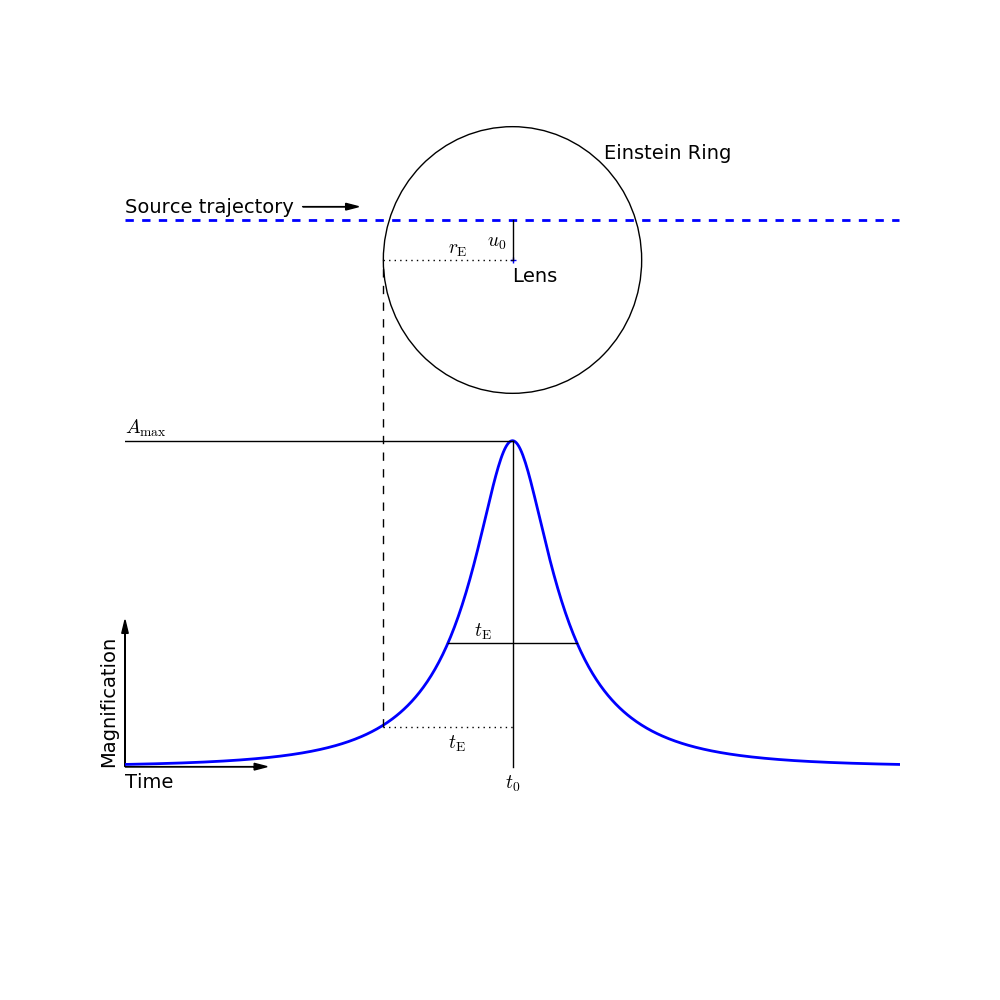
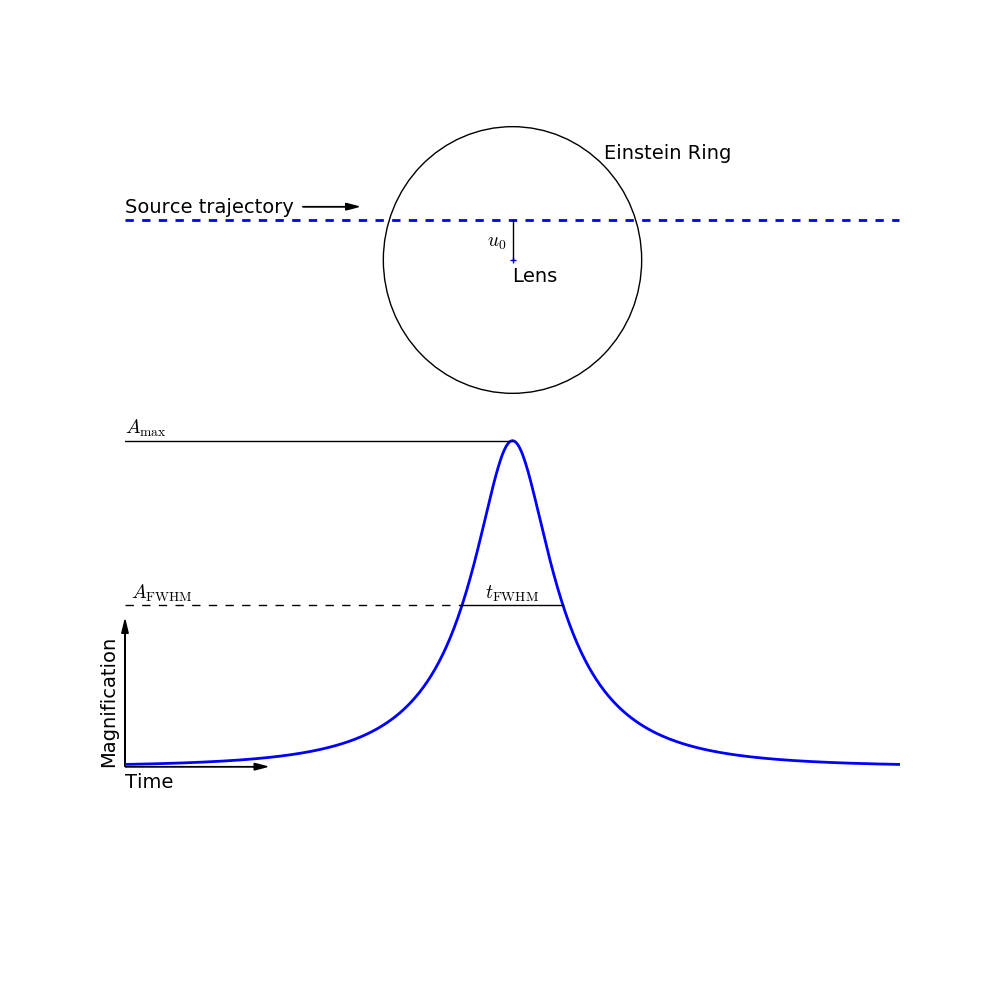
Next, we can measure the width of the peak in time at half of it’s maximum magnification to estimate the tFWHM of the lightcurve (FWHM = Full Width Half Maximum). The Einstein crossing time, tE can be calculated using the measured tFWHM and the above equations. In the limit where u0 « 1, tE ~ (1/2)tFWHM/u0.
Extracting Planet Parameters
Gaudi & Gould (1997) showed that the parameters of a planet (s and q) can be approximated analytically based on light curve observables.
Here we use their techniques to estimate the parameters of a planetary event.
Finding the Location of the Planet
First, determine the parameters of the underlying stellar event ( t0, u0, tE) following the method above. Then, measure the time of the planetary perturbation tp:</p>
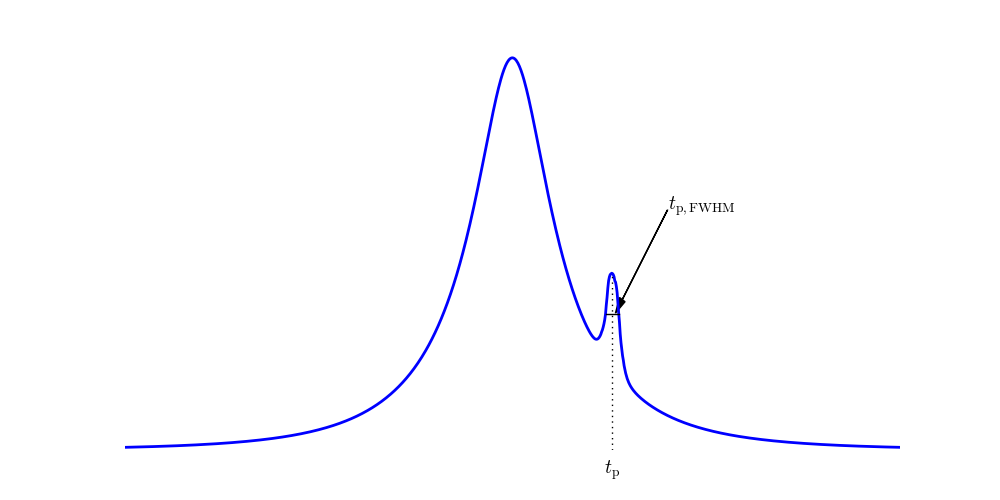
Combined with the point lens parameters, you can calculate \(\tau\) and therefore, u at that time. This gives the source position relative to the lens. Since a planet must perturb one of the images to be detected, to first order, this means the planet must be at the location of one of the images:
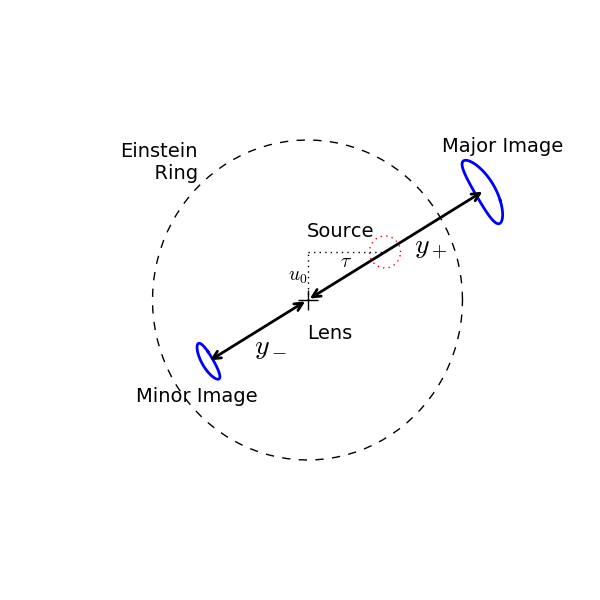
The position of the images is given by: \(y_{\pm} = \pm \frac{1}{2} (\sqrt{u^{2} + 4} \pm u)\), so the planet location, s must be either y+ or y-.
If the planet perturbs the minor image, it will tend to destroy that image, leading to a decrease in magnification. On the other hand, a planet will always further magnify a major image:
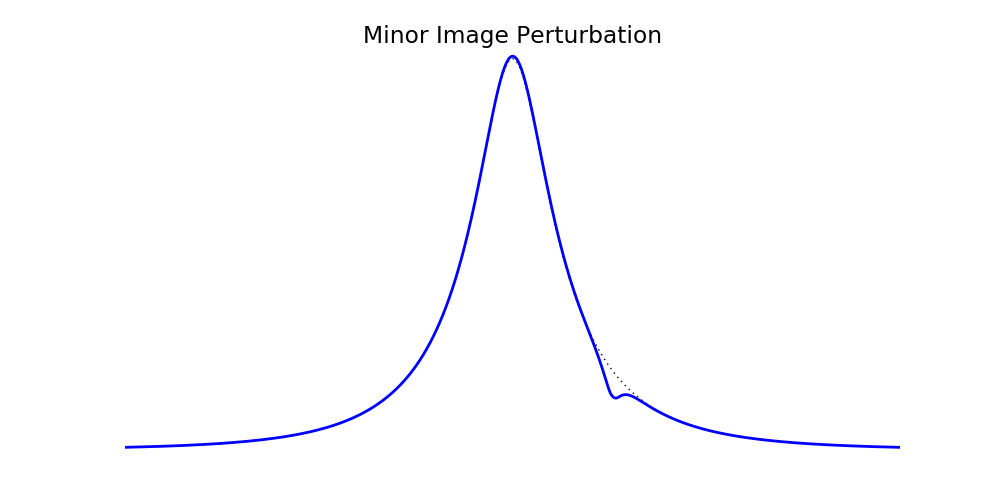
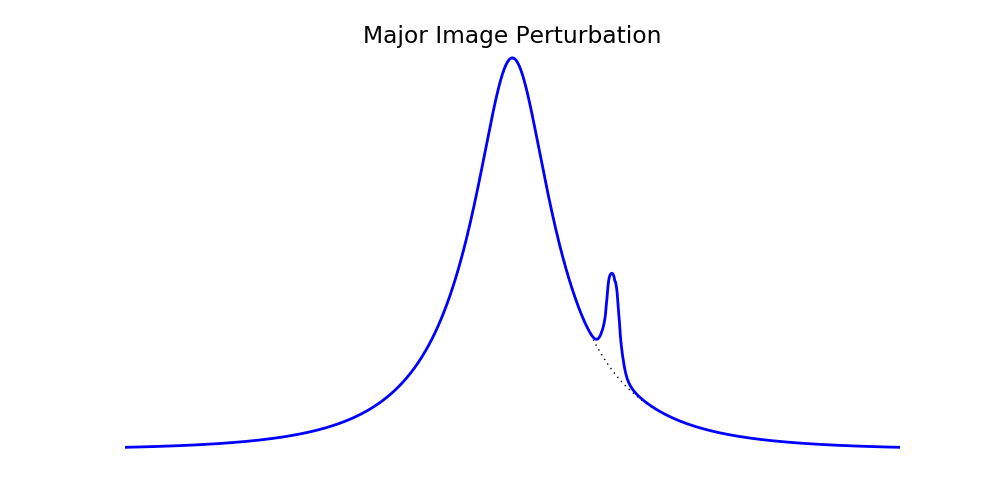
Therefore, the form of the perturbation will show which solution is correct.
Finding the Mass Ratio of the Planet
The size of the Einstein ring is proportional to the square root of the mass: Einstein Ring = \(>\theta_{E} \propto M^{1/2}\). Therefore, the ratio of the duration of the planetary perturbation to the duration of the event should be proportional to the square root of the mass ratio.
Equivalently, mass ratio \(= q = \frac{m_p}{M_{star}} = \frac{t_{E,p}^{2}}{t_{E,star}^{2}}\).
Estimating the source trajectory
For binary events with clear anomalies, the lens-source relative trajectory angle, \(\alpha\) can be estimated from the expression Han et al.(2019):
\[\alpha = \tan^{-1}\left ( \frac{u_{0}t_{E}}{t_{anom} - t_{0}} \right) \approx 2.5\,radian,\]where \(t_{anom}\) is the time of peak anomaly and all other parameters have their usual meanings.