Finding Planets
Introduction
The fundamental scale in microlensing is the Einstein ring whose size is proportional to the square root of the mass of the lens. Given that planets are 10-3 to 10-5 times less massive than their host stars, a microlensing event is dominated by the signal from the lens star. Because a planet is so much smaller than its host star, its microlensing signal will be a much smaller perturbation superposed on the light curve of the host star.
Some of the following light curves have planetary signals, and some do not. Can you tell which ones are planets?
Exercise developed by J.C. Yee
MOA-1998-BLG-033
Published in Gaudi et al. (2002), ApJ, 566, 463
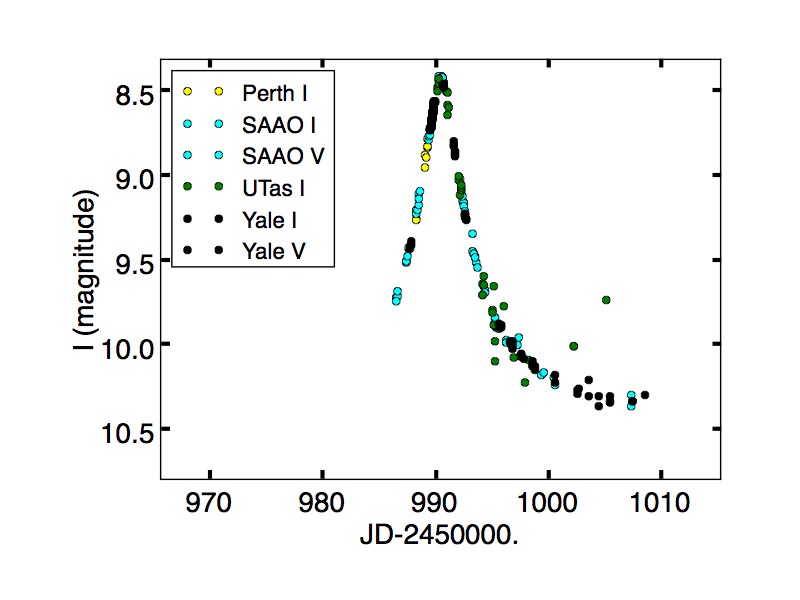
Is there a planet?
OGLE-1998-BLG-014
Published in Gaudi et al. (2002), ApJ, 566, 463
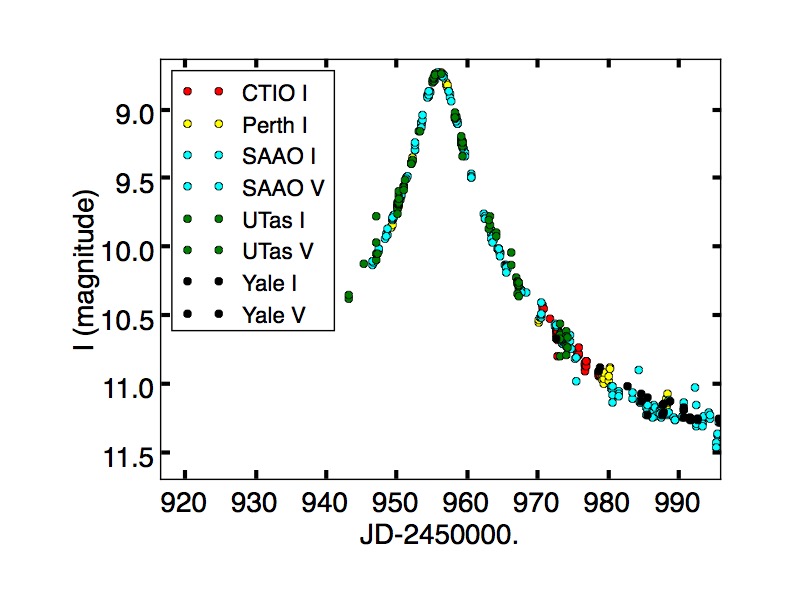
Is there a planet?
OGLE-1999-BLG-036
Published in Bond, Udalski, Jaroszyński, et al. (2004), ApJL, 606, 155
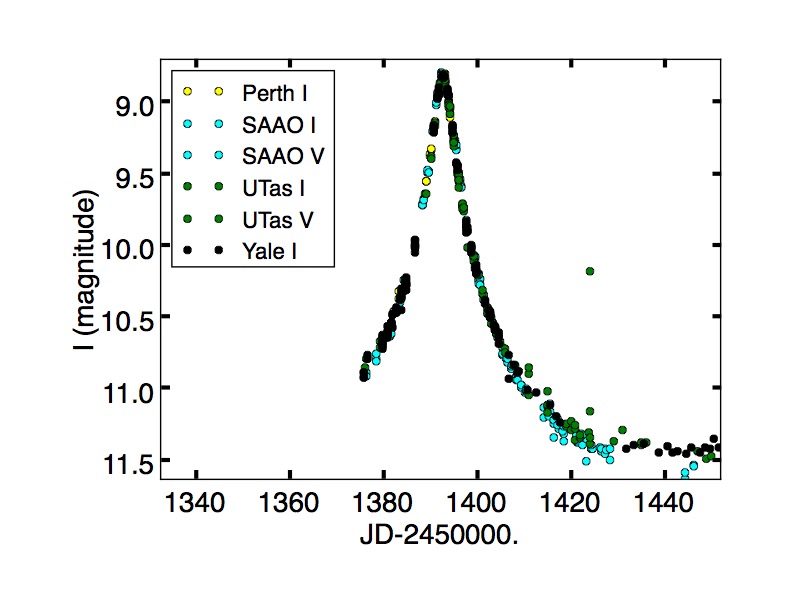
Is there a planet?
OGLE-2005-BLG-390
Published in Beaulieu, Bennett, Fouqué, et al. (2006), Nature, 439, 437
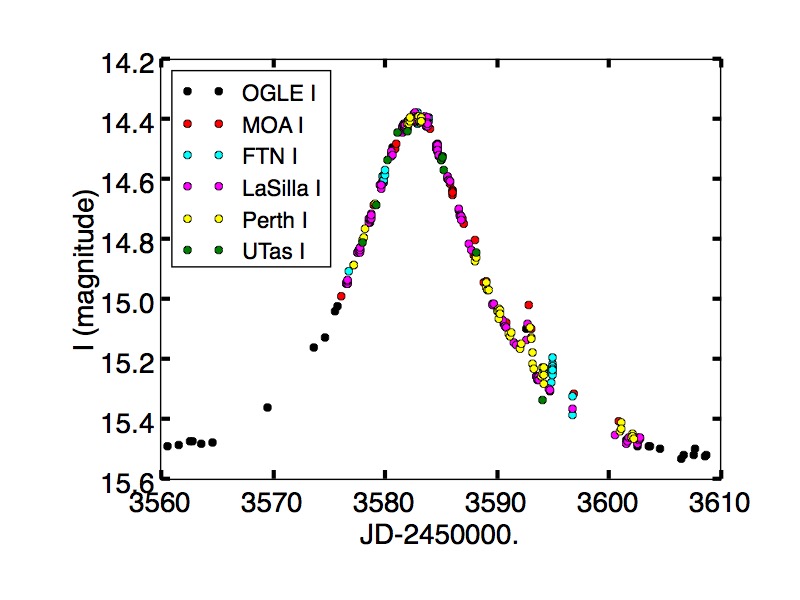
Is there a planet?
References
Gaudi et al. (2002), ApJ, 566, 463
Bond, Udalski, Jaroszyński, et al. (2004), ApJL, 606, 155
Beaulieu, Bennett, Fouqué, et al. (2006), Nature, 439, 437