Worksheet for MOA-2011-BLG-028L
When a microlensing event happens to occur in a region monitored by multiple surveys, it is
often detected by more than one. When this happens, the convention is that the names applied
by each survey are concatenated in the order in which they announced the discovery. This event
is properly named “MOA-2011-BLG-028/OGLE-2011-BLG-0203”, as it was discovered independently by the
MOA and OGLE surveys.
You can read a full account of this event in Skowron, J. et al. (2016), ApJ, 820, id.4.
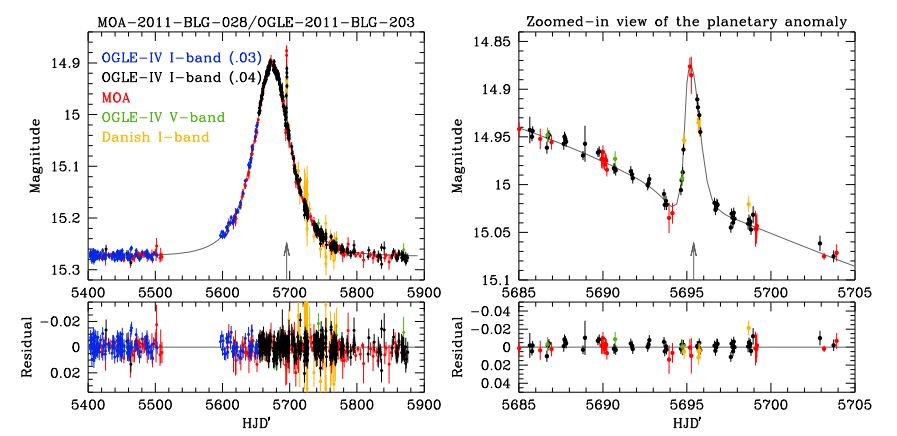
Use the methods outlined in estimating parameters to derive approximate values for the microlensing model parameter.
Parameters of the Underlying Stellar Event
Based on the microlensing light curve, figure out the following properties of the microlensing event:
| Your answers | ||
|---|---|---|
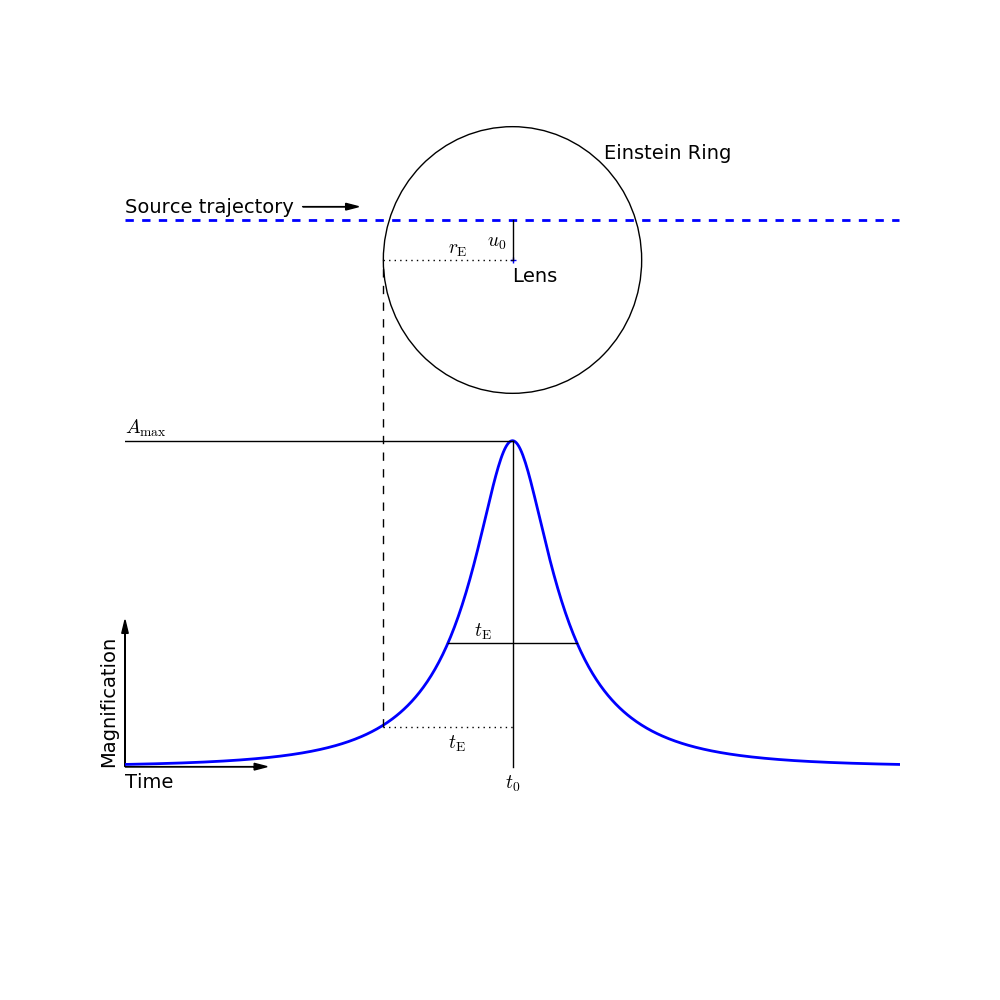
| Time of the peak of the event = t0: | ||
| Change in magnitude = Δm: | ||
| Maximum magnification = Amax: | ||
| Impact parameter = |u0|: | ||
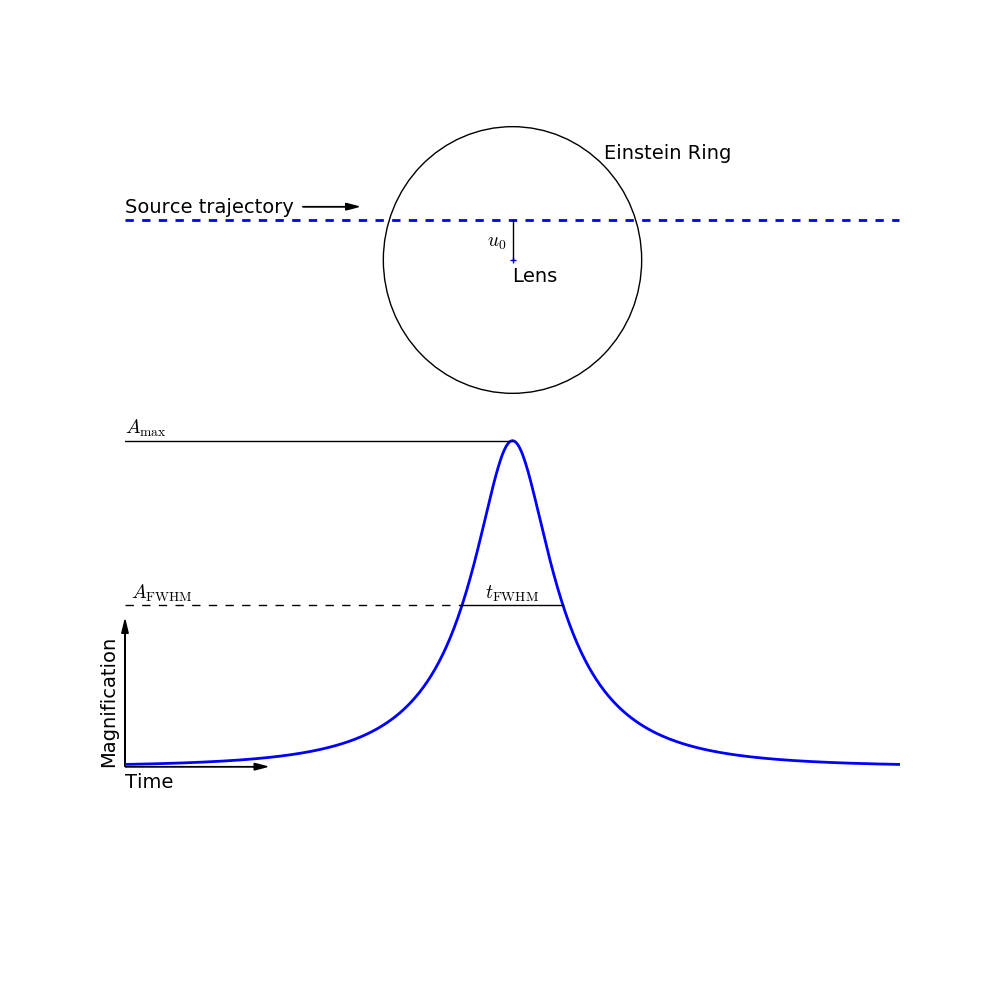
| Magnitude at Half-Maximum = | ||
| Full Width Half Maximum = tFWHM: | ||
| Einstein Timescale = tE: |
Parameters of the Planetary Event
1. Where is the planet?
| Your answers | ||
|---|---|---|
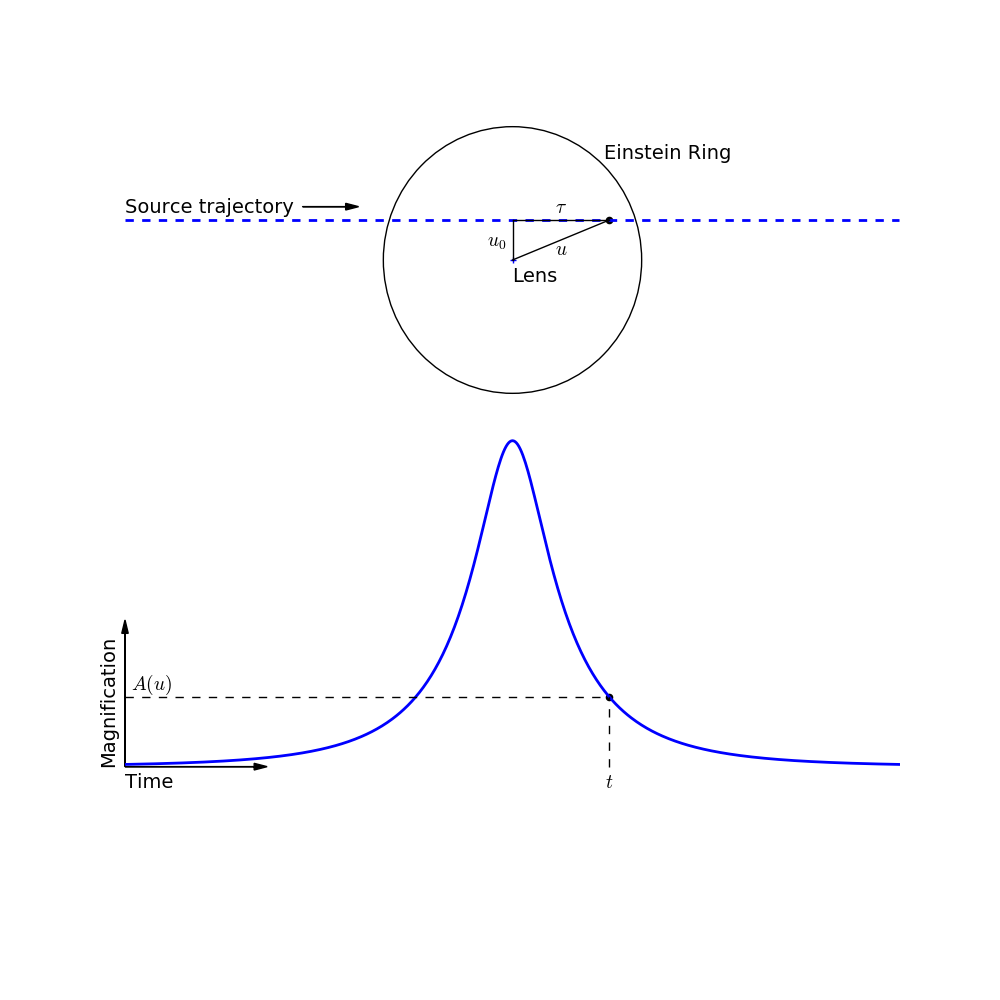
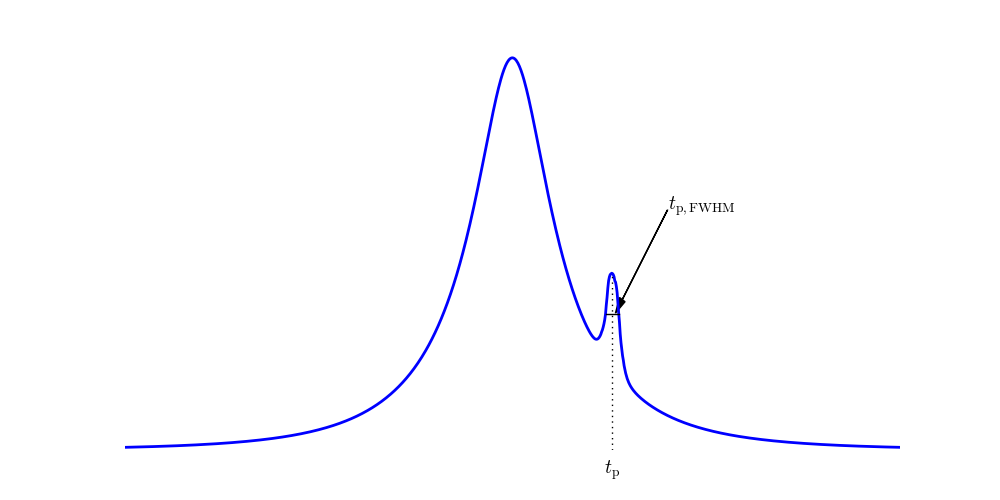
| Time of the the planet perturbation = tplanet : | ||
| Time scaled to the Einstein timescale = τ = |tplanet - t0|/tE : | ||
| Source-lens separation = u = √(u02 + τ2) : | ||
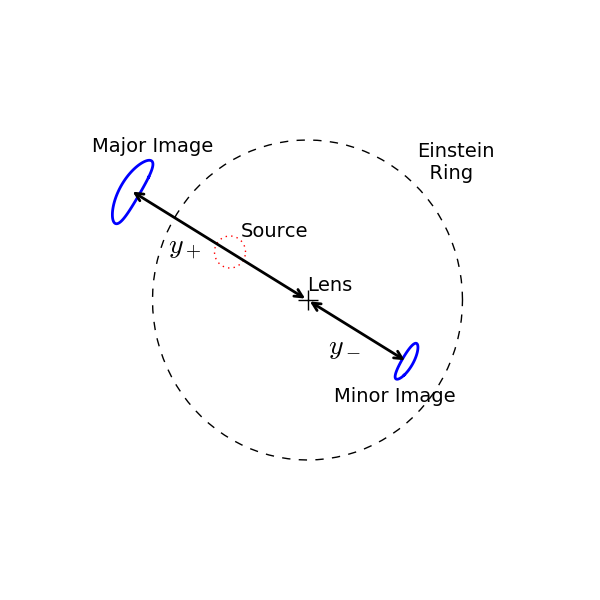
| y± = ± (½) (√(u2 + 4) ± u) : | ||
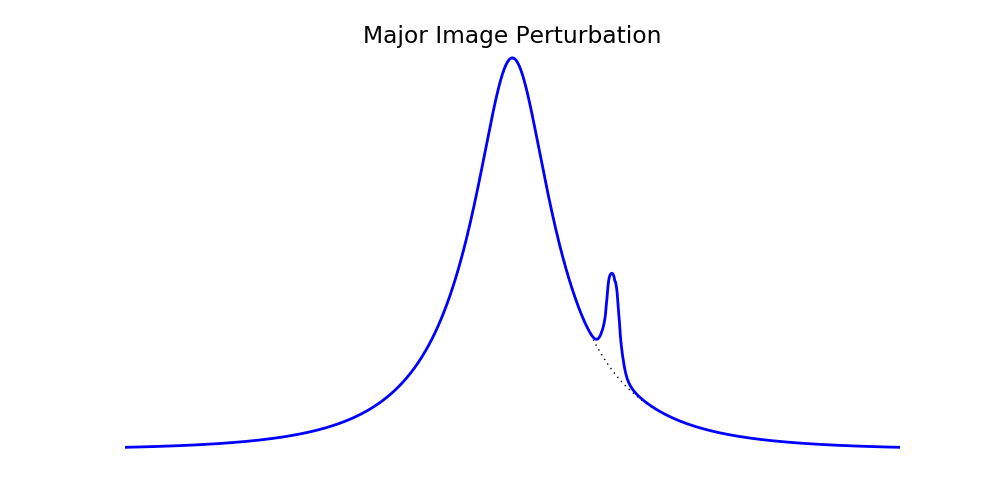
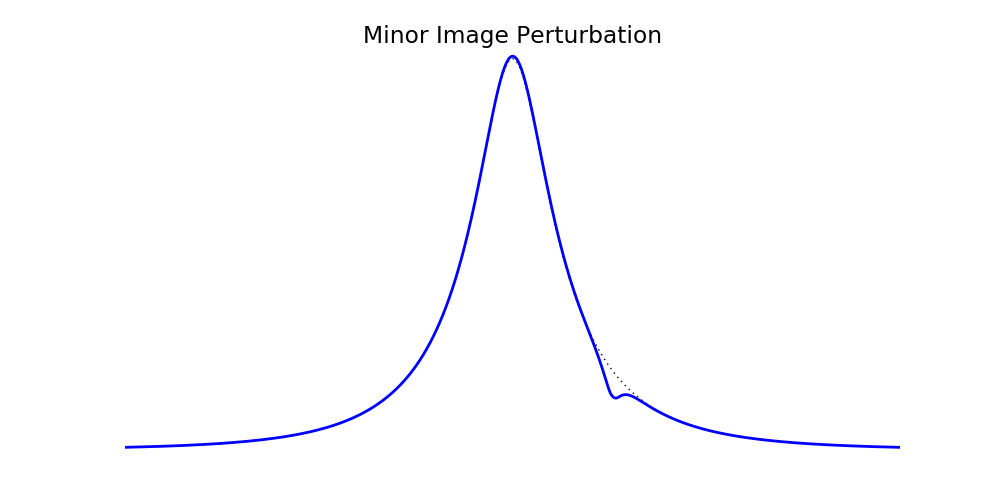
| Is the perturbation a major image (+) or minor image (-) perturbation? | ||
| Location of the planet = s : |
2. What is the mass ratio between the planet and the star?
| Your answers | ||
|---|---|---|
| Planet Einstein Timescale = tp,E ~ tFWHM : | ||
| Mass Ratio = q = (tp,E / tE)2: |
| Planet | q = Planet Mass/Sun's Mass |
|---|---|
| Jupiter | 10-3 |
| Neptune | 5 x 10⁻⁵ |
| Earth | 3x 10⁻⁶ |
| Your answer | ||
|---|---|---|
| Is the planet more similar to Earth, Neptune, or Jupiter? |
How well did you do?
Remember that these methods are approximate - they are used to find a good starting point for analysis. It’s important to remember that the approximation works less well as s–> 1.
IF the light curve is in magnitudes (rather than magnification): We’re assuming zero blending, i.e. that all the light that you see is from the source star. If there is some other (non-lensed) light blended with the light curve, then the true magnification is higher. How do your answers change if you assume that half of the baseline flux is due to a blend? What if 90% is due to a blend?