Blended light degeneracy
Introduction
Microlensing events are most frequently detected in crowded star fields, where
there are substantial populations of sources and foreground lensing objects.
Unfortunately, the density of the stars can result in blending, with the Point
Spread Functions (PSFs) of stars overlap. This is discussed in detail in blending.
Blended light from nearby stars can lead to degeneracies in two cases, described by Woźniac and Paczyński (1997).
Large impact parameters
Recall that \(A_{\rm tot} = \frac{u^{2}+2}{u\sqrt{u^{2} + 4}}\), where the impact parameter u is given by \(u^{2}(t) = u_{0}^{2} + \left ( \frac{t - t{0}}{t_{0}} \right )^{2}\), reaching a minimum of \(u_{0}\) at \(t_{0}\). For a source star of unlensed flux, \(F_{s,0}\), the magnified flux as a function of time is given by \(F_{s}(t) = F_{s,0} A(t)\). Here, the baseline flux (before and after the event) measured from the blended stars, \(F_{0}\), is a combination of flux from the source and other stars.
Where \(u_{0}\gg1\), the expression for magnification becomes \(A \approx = 1 + \frac{2}{u^{4}} = 1 + \frac{2}{[u_{0}^{2} + (t/t_{E})^{2}]^{2}}\), where \(t_{0}\) = 0.
Using these equations, we can derive an expression for the ratio between the source and total flux in the limit where \(u_{0} \gg 1\).
\(\frac{F(t)}{F_{0}} = (1 - f_{s}) + f_{s} \left( 1 + \frac{2}{(u_{0}^{2} + (t/t_{E})^{2})^{2}} \right) = 1 + \frac{2 f_{s}}{(u_{0}^{2} + (t/t_{E})^{2})^{2}}\), where \(f_{s}\) is the fraction of the measured light coming from the source.
Woźniac & Paczyński demonstrated that it is possible to substitute
\(f_{s}^{\prime} = f_{s}C^{4}, u_{0}^{\prime} = u_{0} C, t_{E}^{\prime} = t_{E} C^{-1}\) where C is an arbitrary positive constant into the equation above and still obtain the same expression for the flux ratio.
This means that there is a degeneracy between blended flux, impact parameter and the Einstein crossing time. The additional flux makes the event brighter at baseline than the true source alone, and effectively means that the event can appear to have a longer tE and lower impact parameter than it actually does.
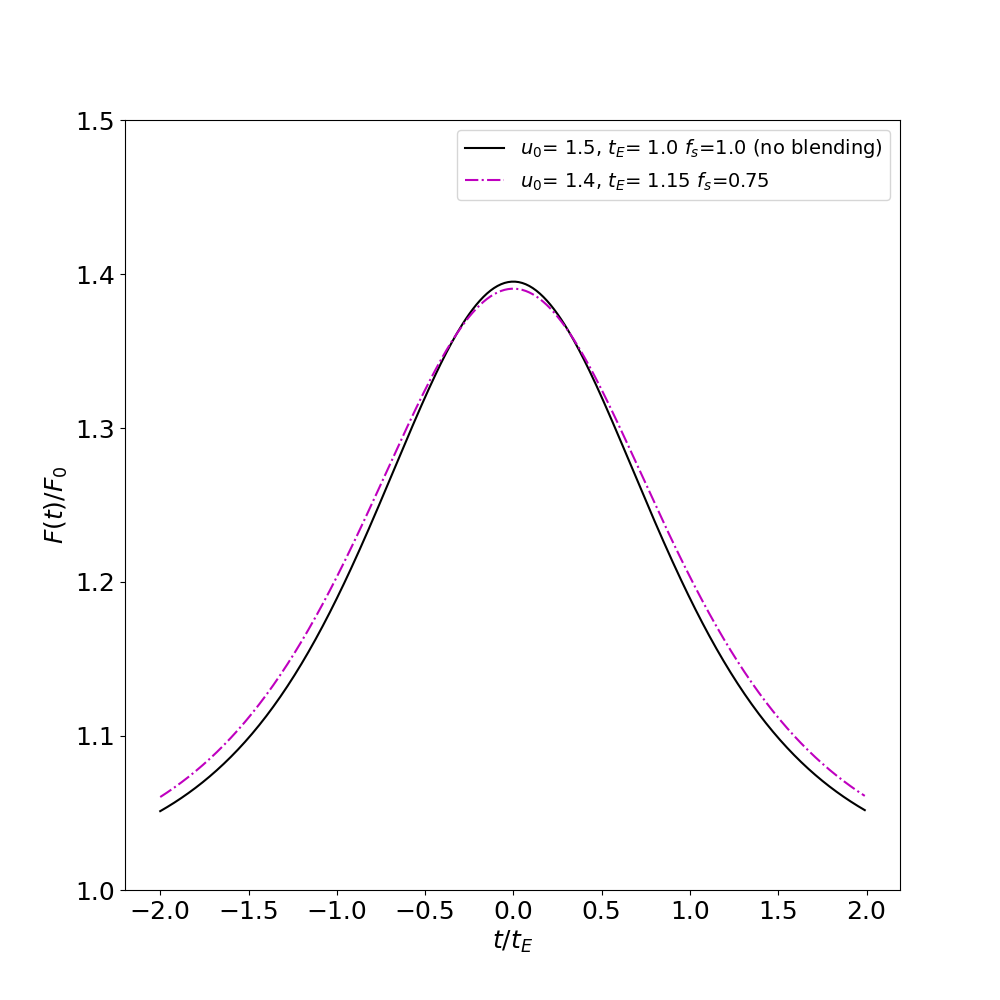
An important aspect to note here is that although formally this degeneracy affects events with impact parameters greater than 1.0, in practise it is significant even for \(u_{0}<1.0\).
Heavy blending
The second instance where blending can cause degeneracies is when the source is faint compared with the total flux from its blended neighbors (i.e. \(f_{s} \ll 1\)). This is a common scenario in the crowded star fields of the Galactic bulge. We can only detect lensing in such cases when the peak magnification is high (and \(u_{0}\) is small), that is \(A \approx 1 + u^{-1}\).
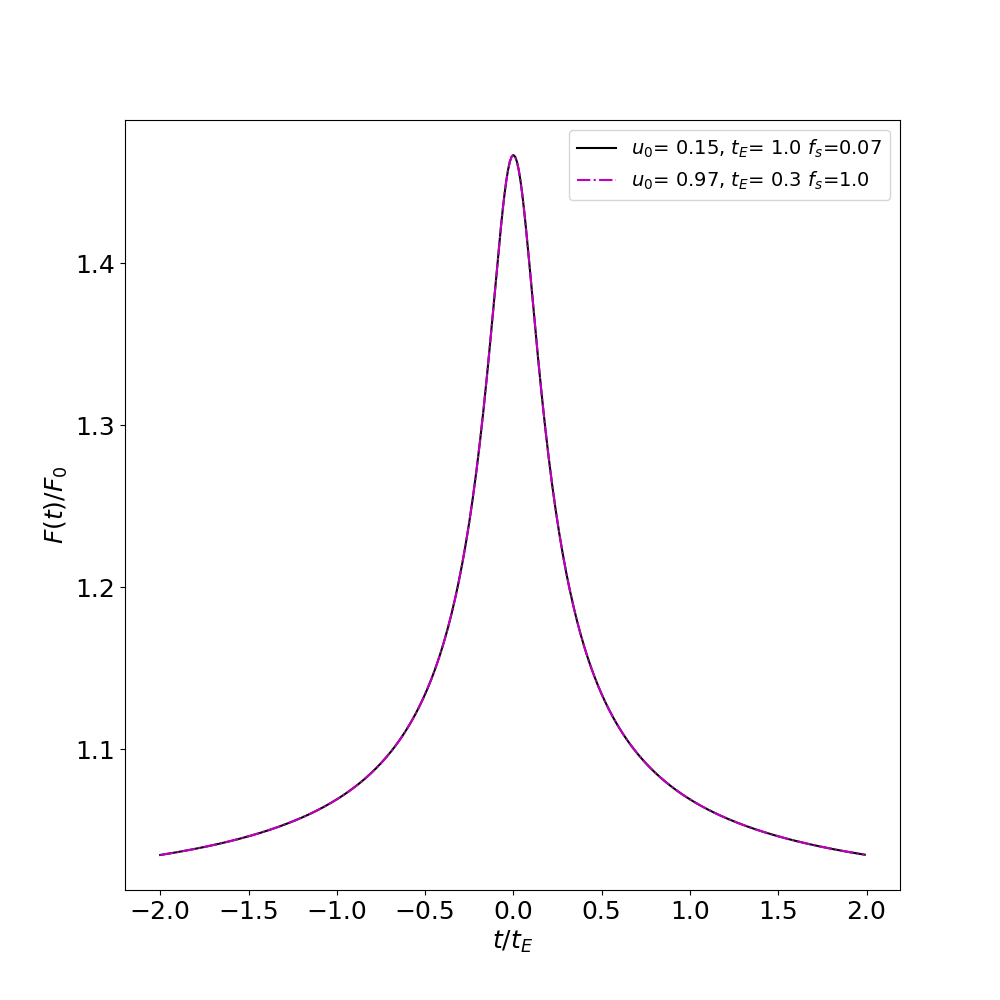
In this case, the flux magnification becomes:
\[\frac{F(t)}{F_{0}} = 1 + \frac{f_{s}}{(u_{0}^{2} + (t/t_{0})^{2})^{1/2}}.\]Once again we can explore the behaviour by substituting the main parameters for values multiplied by a common constant:
\[f_{s}^{\prime} = f_{s} C, u_{0}^{\prime} = u_{0} C, t_{0}^{\prime} = t_{0} C^{-1}.\]This recovers the same expression as above, demonstrating the degeneracy as illustrated in the plot above. This implies that heavy blending of a source can effectively “mask” the true magnification and Einstein timescale.
Blending and tE
The information on an event’s \(t_{E}\) is derived mostly from the “wings” of the lightcurve. Since by definition this is when the event is fainter, this coincides when the photometric noise is greatest, and also when the source flux is more difficult to distinguish from the flux of blended neighbors. As explained in blended light, blended light can make an event timescale appear smaller than it actually is. Since \(t_{E} = \theta_{E}/\mu_{rel}\), where \(\mu_{rel}\) is the lens-source relative proper motion, and the angular Einstein radius, \(\theta_{E}\) depends on the mass of the lens:
\[\theta_{E} = \sqrt{ \frac{4GM_{L}}{c^{2}}} (D_{L}^{-1} - D_{S}^{-1}),\]blending can lead to misleading estimates of the lens masses. This can be particularly important for the very short duration events thought to be caused by Free-Floating Planets (see e.g. Mróz et al.(2017)).
References
Mróz et al.(2017) Nature, 548, 183)
Woźniac and Paczyński (1997) ApJ, 487, 55