Wide degeneracy
The wide degeneracy affects binary events where the planet lies at a wide separation from it’s host star, and the source’s relative trajectory crosses the planetary caustic. It was described by Sumi et al.(2016), to explain event MOA-2013-BLG-605Lb.
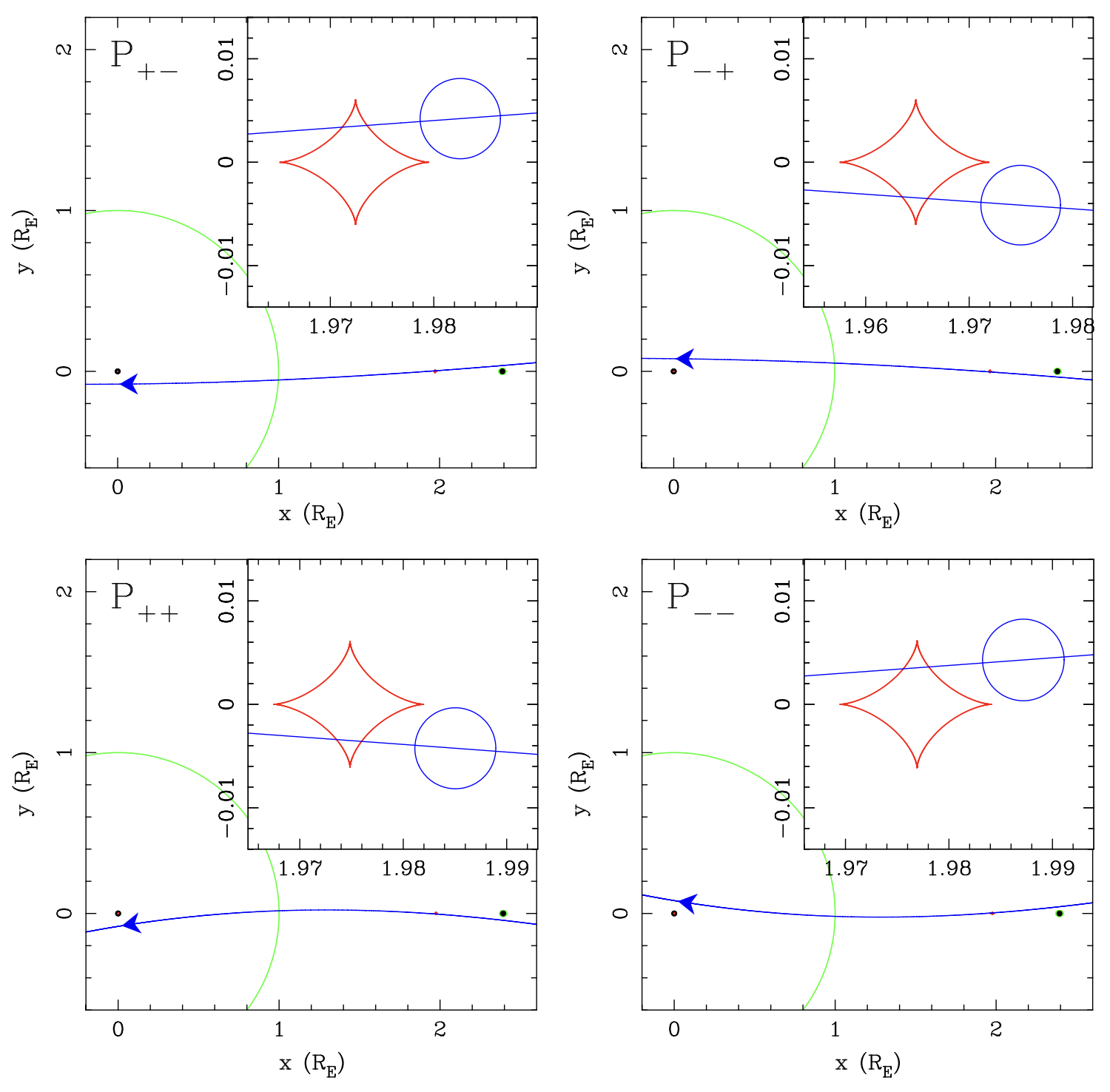
This event exhibited two degeneracies, the ecliptic degeneracy (indicated by the first model suffix) and the wide degeneracy (indicated by the second), resulting in a quartet of models resulting in similar lightcurves. The wide degeneracy is a consequence of the symmetry of the diamond-shaped central caustic in a planetary event.
Taking parallax into account results in a curved source relative trajectory when plotted in the lens plane, meaning that \(\alpha\) varies as a function of time. As a result, the value of \(\alpha\) at the \(t_{0}\) (dominated by the primary mass lens) is not the same as the value of \(\alpha\) at the time of caustic crossing.
In the case of the event MOA-2013-BLG-605Lb, the source trajectory can curve above or below the planet in the lens plane and still create the same lightcurve.